BiographyLos Angeles • Prague

A life shaped
by contrast.

From communist Prague and post-Wall Berlin to the expansive creative field of Los Angeles, Maxim Havlíček’s life has been a sustained movement between discipline and freedom, language and gesture, reason and intuition.

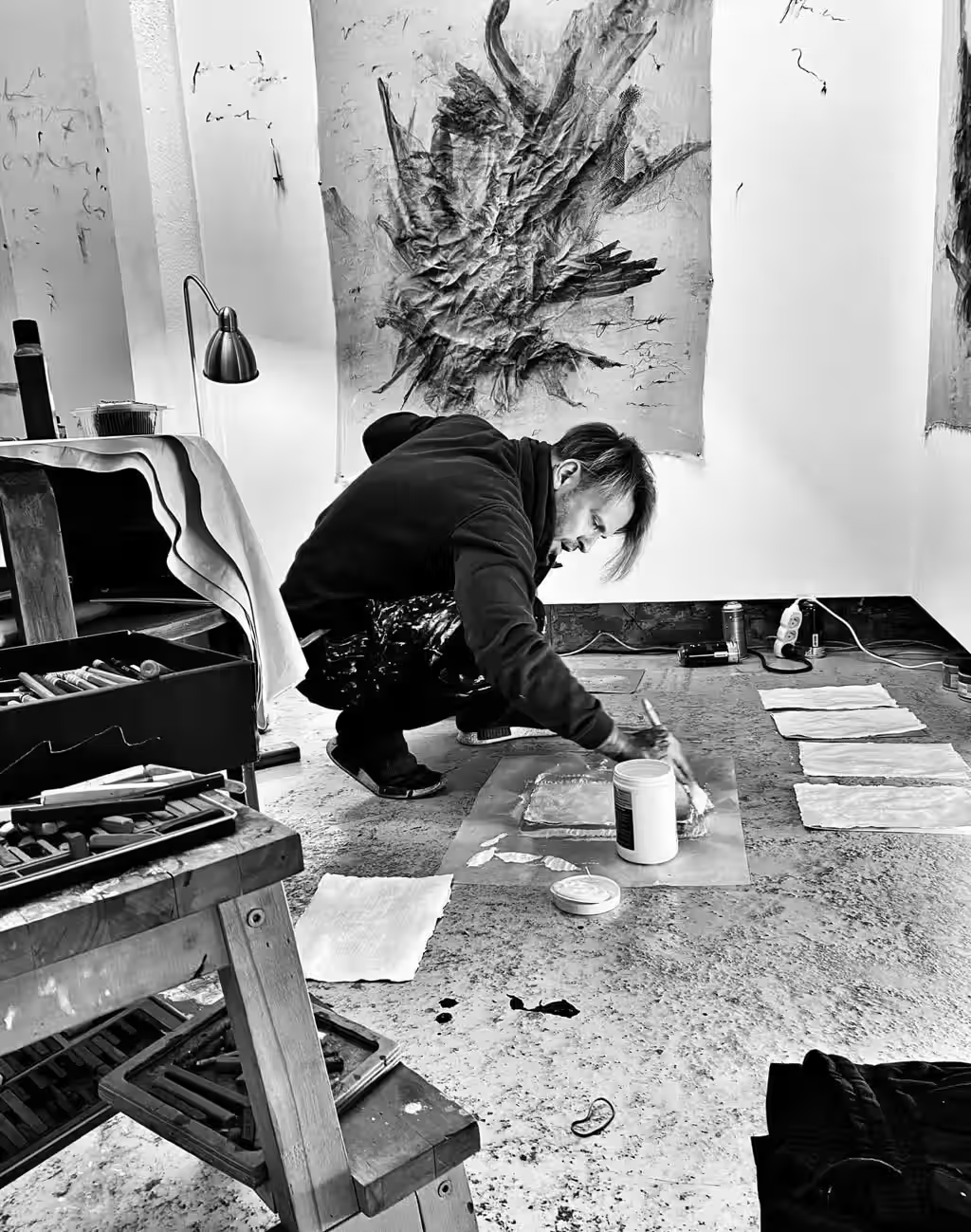
Maxim Havlíček in his studio

01

Prague: the first language

Maxim Havlíček was born on July 31, 1974, in Prague, then Czechoslovakia. His childhood unfolded under a communist regime whose emphasis on order and conformity sharpened his desire for freedom and self-expression. An uncle’s attic studio offered an early counterworld: a place of experimental canvases, material possibility and creative independence.

At the Graphic Arts School on Hellichova Street, Havlíček trained across drawing, graphic design, lithography, photography and calligraphy. The discipline of the written mark—its precision, rhythm and physical execution—would later become central to his painting. Prague itself remained a formative presence: Gothic architecture, medieval mysticism, Kafka’s existential legacy and the release of energy after the Velvet Revolution all entered his developing visual imagination.

02

Berlin: art as lived freedom

In the mid-1990s, Havlíček entered Berlin during the second wave of post-Wall squatting. Around Kunsthaus Tacheles and the city’s self-organized underground, the borders between studio, exhibition, performance and daily life were deliberately porous. Encounters with artists including Marek Schovánek encouraged experimentation outside established formats.

Berlin changed the scale of what an artistic life could mean. Art was not treated as a separate professional category, but as a mode of survival, community and resistance. That experience strengthened Havlíček’s willingness to work across media and to let uncertainty, accident and physical action become active forces in the work.

03

America: distance and reinvention

Havlíček moved to the United States in 1999. The move created both geographical and psychological distance from Europe, allowing earlier influences to be re-examined rather than simply repeated. Photography, digital processes and collaborative work remained part of his practice; Sonneteer, made with Doug Fogelson in 2006, brought photography and digital painting into a shared visual field.

He settled in Los Angeles in 2011 and established a studio there. The city’s openness, scale and cultural multiplicity marked a decisive turn: Havlíček embraced painting as the primary form through which he could bring intellectual research, bodily action and intuition together. Los Angeles and Prague now form the two poles of his practice—one associated with expansion and reinvention, the other with memory, language and historical depth.

04

A practice built in series

Havlíček does not begin with sketches. A body of work starts with sustained research into a subject—sometimes over many months—until the conceptual structure has been absorbed. In the studio, that preparation gives way to concentrated, intuitive execution. Music, materials and the arrangement of the workspace establish the conditions; then each mark answers what is already present on the surface.

The paintings develop in series because no single canvas is expected to contain the whole investigation. Prologue and The Alchemist retained figures, faces and fragments of legible language while subjecting them to erasure and transformation. Time Traveler displaced the body into shadow and absence. Ab Initio and Parallel Universes turned toward origins, perception and multiple states. Resurrection made precious material and reflected light part of the work’s changing appearance. The Last Missing Piece and Anima Mundi expanded writing into dense, open fields without a fixed center.

05

Writing without language

Calligraphy entered the paintings first as readable language. As the speed of thought exceeded the speed of handwriting, words shortened into abbreviations, recurring signs and a personal cipher. Living between Czech and English intensified the transformation: a third visual language emerged, derived from both but belonging fully to neither.

These marks are not texts waiting to be decoded. They register movement, pressure, duration and state. A line gains meaning through its response to the preceding line and through what it makes possible next. Writing becomes a temporal structure; the body performs it, and the trace retains the time of its making. In this sense, the paintings do not illustrate a completed thought. They are where prepared thought becomes material form.

06

Material, light and the open field

From 2020 onward, Havlíček increasingly treated the support itself as an active agent. Velvet absorbs light; soft pigments appear or recede as illumination changes; thin layers of gold reflect the viewer’s movement and cast physical shadows. The painting no longer has one stable appearance. It becomes an event that unfolds through time, light and bodily perception.

Across these changes, a consistent handwriting remains—not a repeated motif, but a recurring method of condensation, layering and response. In the current Anima Mundi paintings, calligraphic energy extends across the whole surface. The canvas contains only a section of a field that could continue beyond its edges: structure appears, disperses and forms again.

Source & context

The thinking behind
the paintings.

This biography draws on writings and extended conversations by Anna Kodl, academic advisor to Maxim Havlíček. Her critical study follows the work from its figural beginnings to calligraphic fields, material transformation and the current Anima Mundi series.

Read Painting as a Form of Thinking